
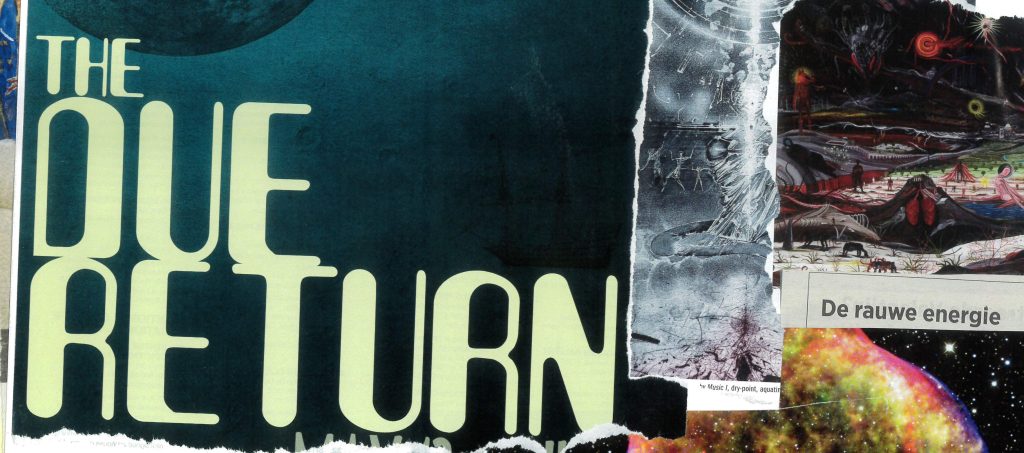
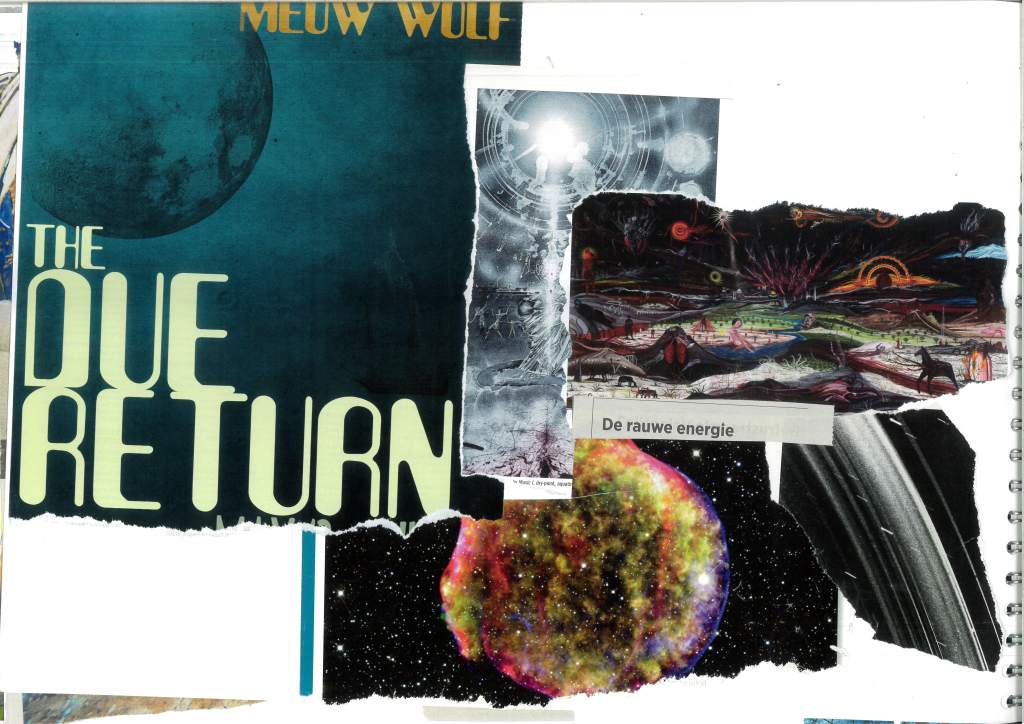
In these two collages, I put together images of what seems like alien worlds. The collection started off with the scraps of National Geographics showing images of space. Looking at them now, I think the collage diptych looks like a story board or one of those criminal investigations boards you see on tv where the detectives have collected their snippets of clues and evidence.
So, backtracking now and finding the story after the fact (because I did little to no planning at the time as far as I can remember), what is the story here?
In this collage, I used images from National Geographic and some art magazines (whose titles are lost to me now). It took me some time to find out what The Due Return was. Initially I thought the image was of a Perry Rhodan sci-fi magazine which didn’t help my search for its source. The image itself I cannot find, but I did find out what Meow Wolf is; an American art company that creates immersive installations. The Due Return was one such installation in Santa Fe in 2011 consisting of an over 70-foot-long, two-story ship divided in rooms. I wish I could have seen it!
From the original Press Release about The Due Return: “Once a seafaring vessel, [The Due Return] now bears the marks of its previous voyages, a hodgepodge of transport devices and retro-fitted technologies. The ship’s interior speaks of its rich history and its passengers. It is a history that is discoverable through a vast fictional archive presented throughout the ship. The foreign environment that the ship resides in is filled with alien flora, fauna, and fungi; glowing trees that interact with audience members, cliff dwellings sprouting mysterious fruits, and creatures that sing alien tunes. The project incorporates video, live performance and extensive interactive elements, to submerge the audience into a fully-operating fictional world.” (Visual Arts Source)


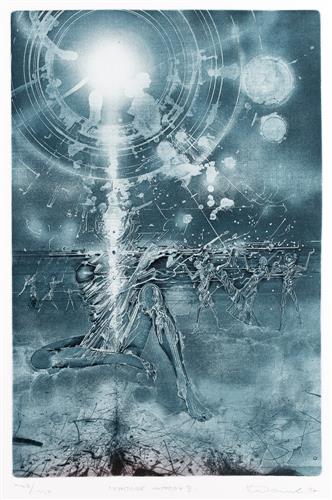
Moving on and around clockwise, there is the work Meditation by Music by Karel Demel. It took me a long time to find this image. Demel was a Czech artist, born in 1942 and passed away not long ago, in July 2024. He worked mainly in printmaking and was inspired by music and poetry, which is clear not only from the title, but from the work as well.
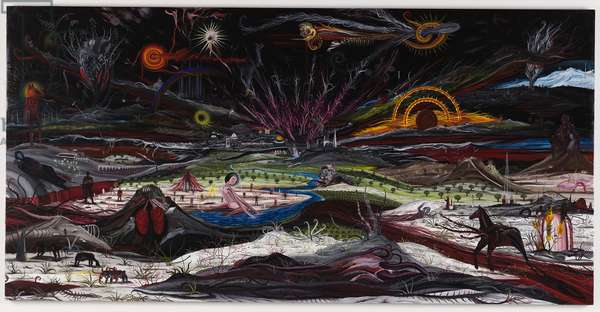
The next work is by Eliezer Sonnenschein (born 1967); Landscape and Jerusalem. Sonnenschein is an Israeli artist who creates works across a wide range of media and technique, such as sculptures, digital photomontages, paintings and installations. His works explore the human experience and often include political criticism (artsy). Landscape and Jerusalem shows a dark landscape with a expansive night sky full of swirling celestial bodies. Beneath them, the landscape stretches into the distance where a city sits on the horizon. Is this Jerusalem? The land is hilly and a river runs between the hills to the city. The landscape is occupied by strange figures, some humanoid, others are more horse-like. It’s a shame I wasn’t able to find a better quality image as a lot of details are now lost in a pixel blur.
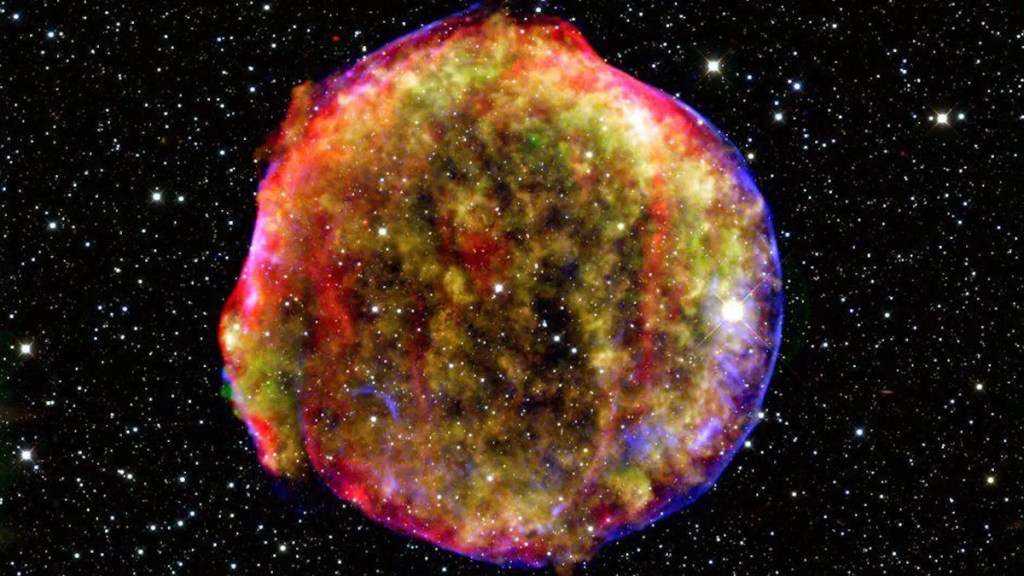
The last image is of the Tycho supernova remnant from a National Geographic. I couldn’t find exactly which issue or in which context it was used. I did find a different article in Live Science Plus (May 25, 2025) that mentions the Tycho supernova remnant. It discusses that scientists suggest that supernovas act like very powerful particle colliders.
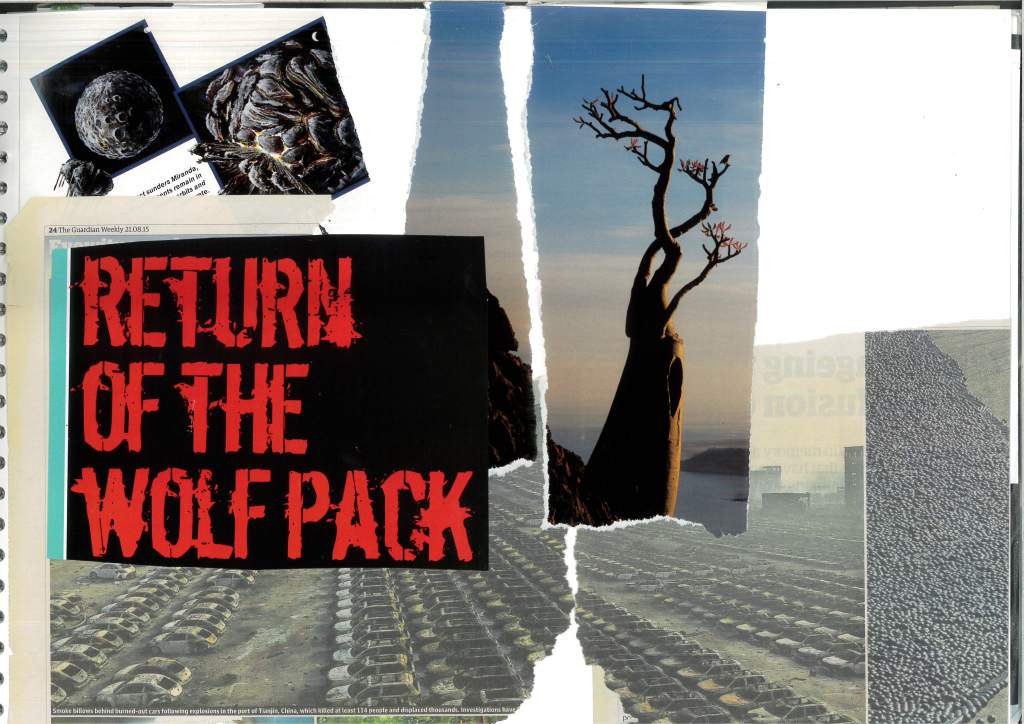
The second collage is only a few images. I imagine I was very pleased to find another piece with the word “return”, the source of which is lost to me now. I can also not find the source of the images above it. However, I can find information on Miranda, one of Uranus’ satellite moons. Reading Astronomy.com‘s article about the moon, I can assume that these two images depict one of the ideas of how the moon was formed to look so unusual.

In the images below you can see the strange collage like surface of Miranda. These photos were taken by Voyager 2 in 1986. Voyager 2 was launched in 1977 and it’s the only spacecraft that has visited all four giant planets (Jupiter, Saturn, Uranus, Neptune) on it’s “Grand Tour”. In 2018 it entered interstellar space and is still sending back date! How cool is that?
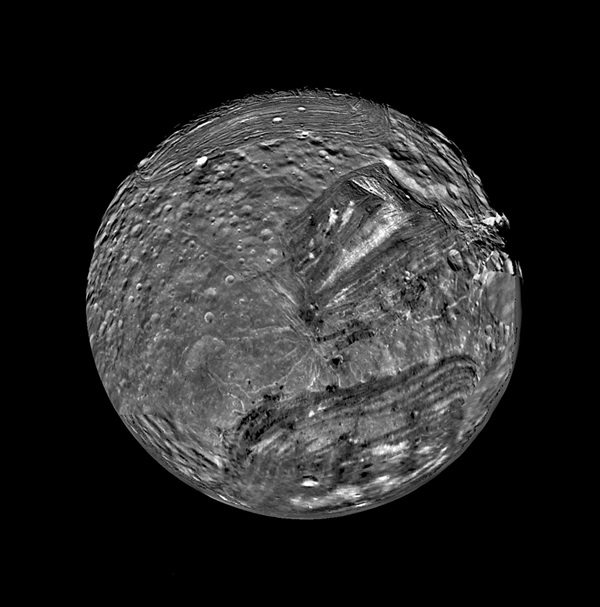
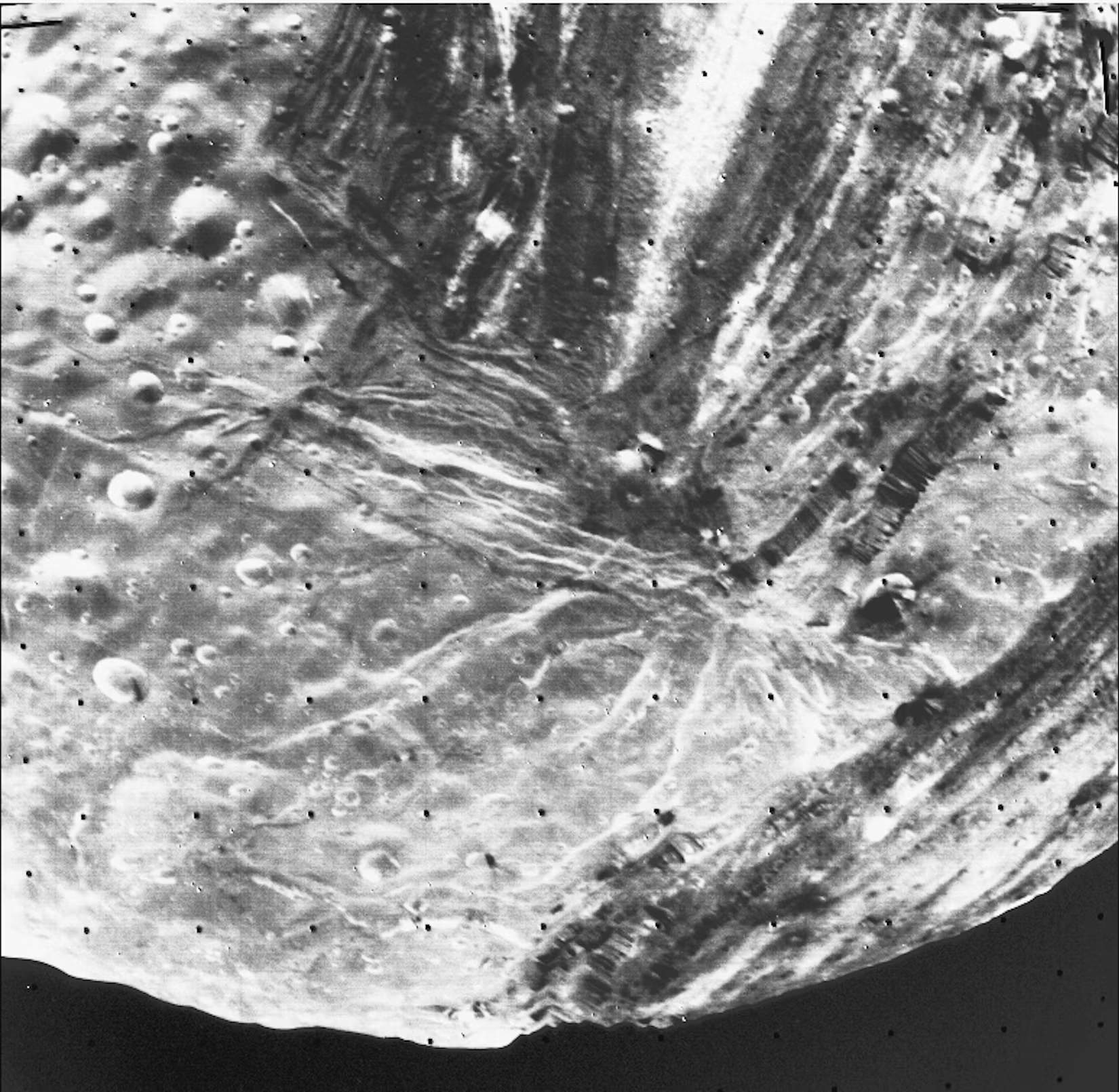

Anyway, one of the theories of how Miranda got such a wonderfully textured and almost painterly surface is that it was scattered repeatedly by collisions before reforming 4 billion years ago. Some of the canyons must have been created by tectonic movement, very unusual for such a small celestial body which likely won’t have much inner heat… The article states: ” Experts say that nearby Uranus “must have” tidally heated the little moon, and that the plastic material “somehow” found a way to ooze up to fashion the carnival of disparate features” (Astronomy.com). I love all the quotation marks.
Moving on to the large newspaper image behind the “Return of the Wolf Pack” image from The Guardian Weekly 21.08.2015. The caption reads: “Smoke billows behind burned-out cars following explosions in the port of Tianjin, China, which killed at least 114 people and displaced thousands. Investigations have…” The rest is torn away. On 12 September The Guardian reported the final death toll to be 173. In a SIESO Medal paper states that it was “one of the world’s largest artificial, non- nuclear explosions”. Looking at images and videos of the disaster is grim and terrifying. After investigation it turned out that much more hazardous material than authorised, including 700 tonnes of highly toxic sodium cyanide and the warehouses were too close to houses (BBC).

China explosions: a visual guide to what happened in Tianjin https://www.theguardian.com/world/ng-interactive/2015/aug/13/tianjin-explosion-china-a-visual-guide-to-the-damage

Photograph by Mark W. Moffett for National Geographic https://www.nationalgeographic.com/photo-of-the-day/photo/desert-rose-socotra-moffett
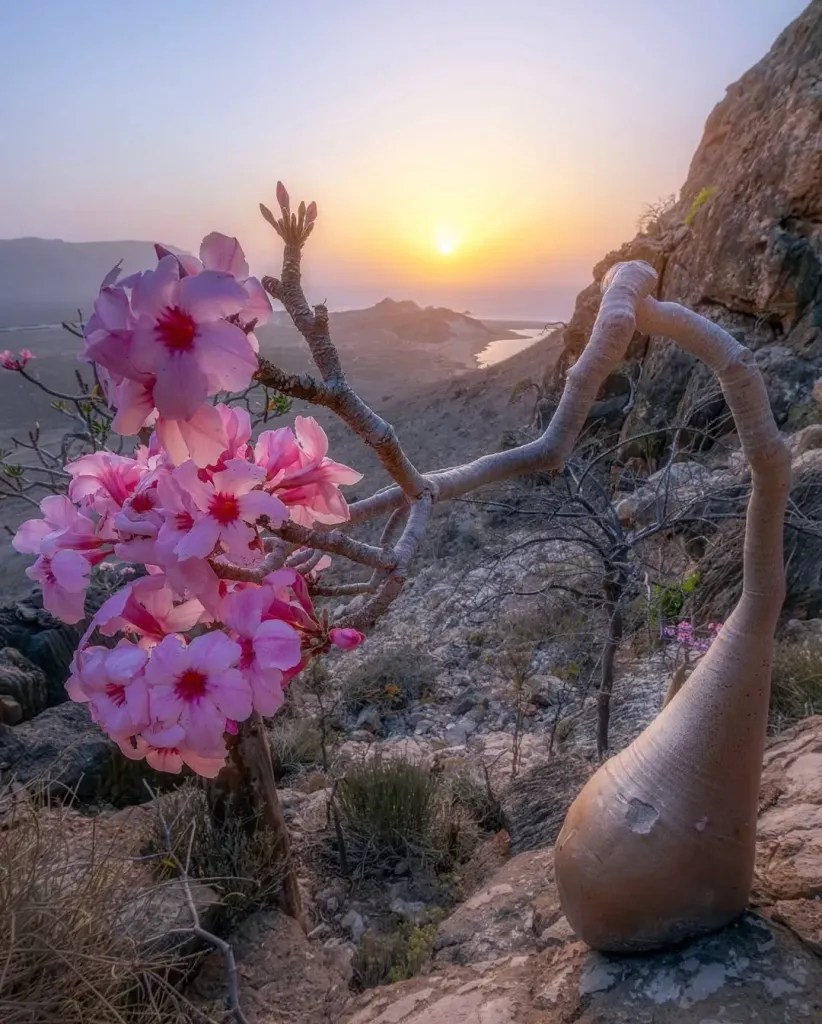
The final image is of the The Socotra Desert Rose, which is a endemic succulent tree (a water-storing plant that is naturally found only in a specific region). This photograph, taken by Mark W. Moffett, was “photo of the day” in the National Geographic’s issue of June 2012. Some facts about this tree is that it’s not related to roses, it stores water in its trunk and it flowers.
Alien worlds, real and imagined, explosions and trees surviving arid climate. Perhaps we don’t need to look beyond reality for beauty and the extraordinary or perhaps we need to escape manmade troubles. I don’t know.

 Where the Art is
Leave a comment