
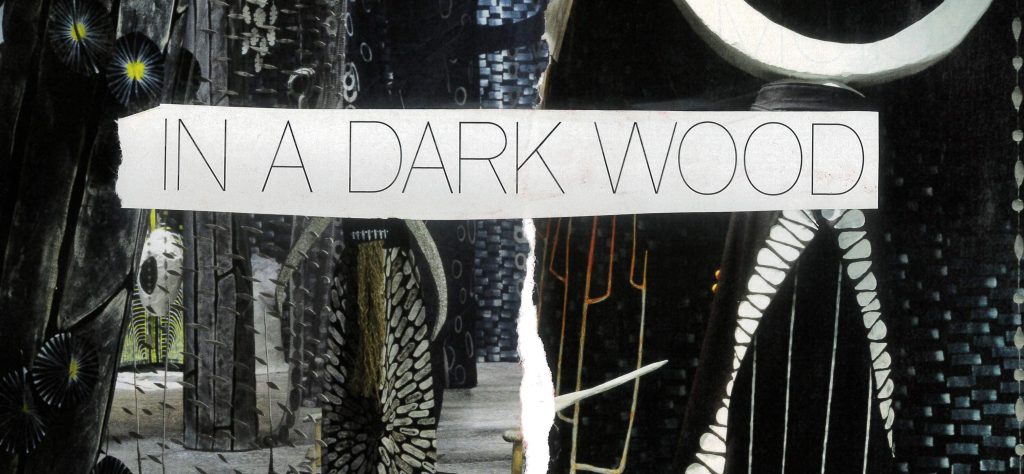
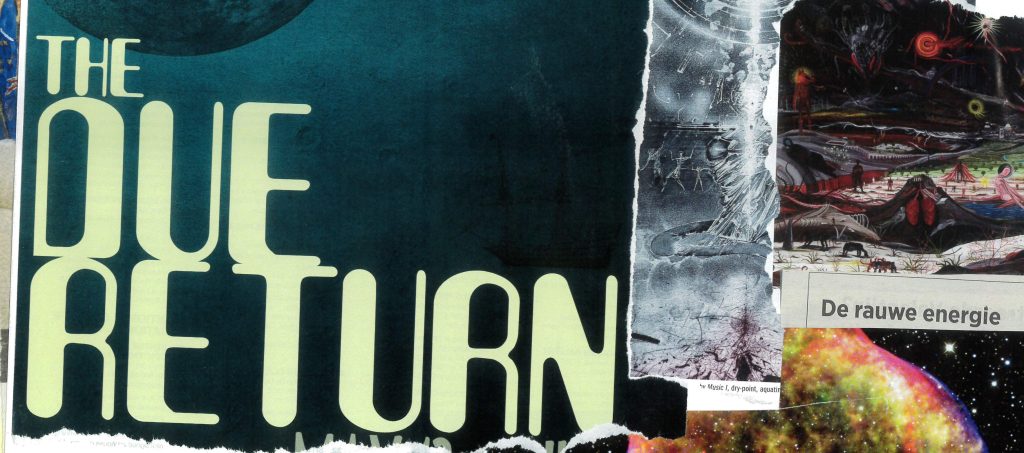
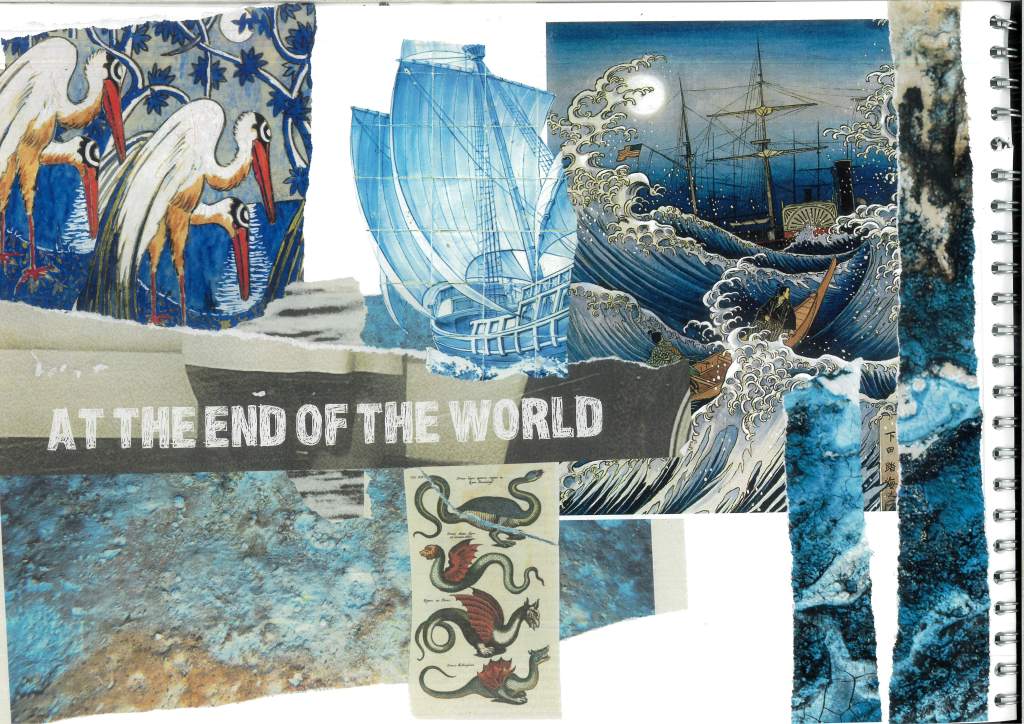
In a Dark Wood is two collages, a diptych. I used found images of from art magazines, old posters and painted scraps. Although they are quite different in colour and value, I feel they belong together. They tell a story of some strange other world not unlike our own. Same same, but different.
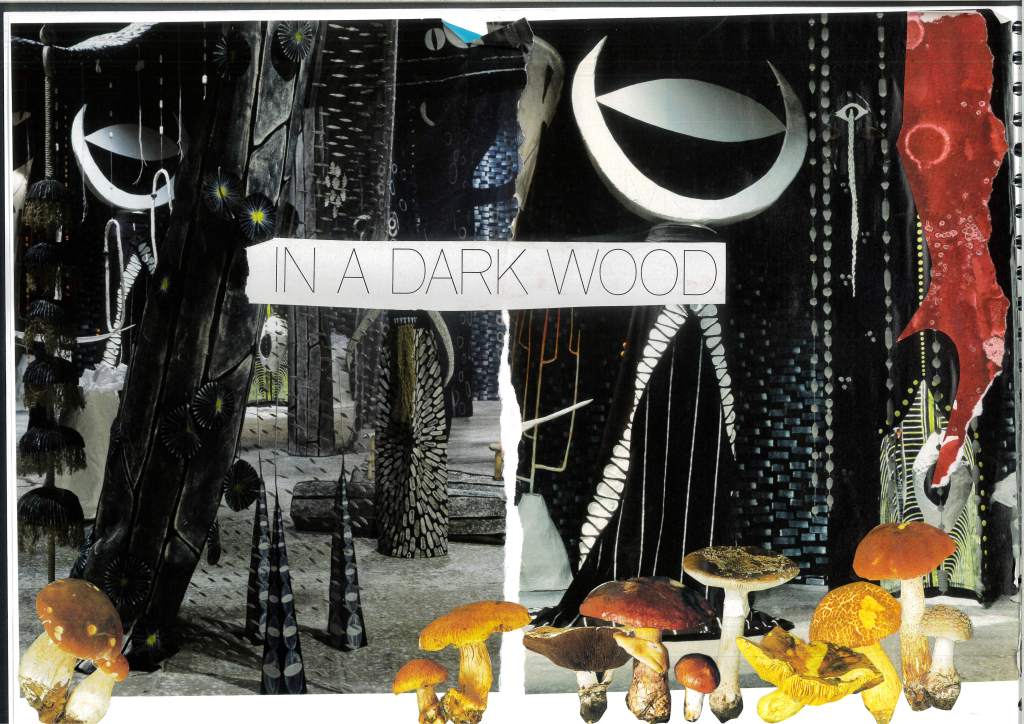
The march of the mushrooms along the bottom and the tear of read pqainted paper connects the landscape across the ring binding.
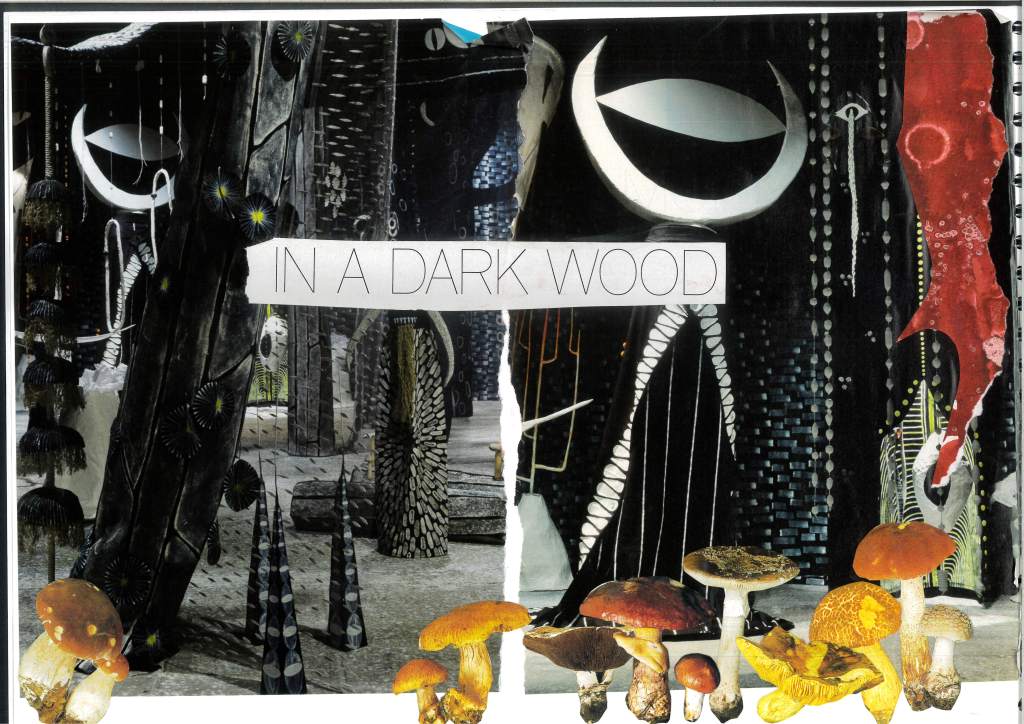
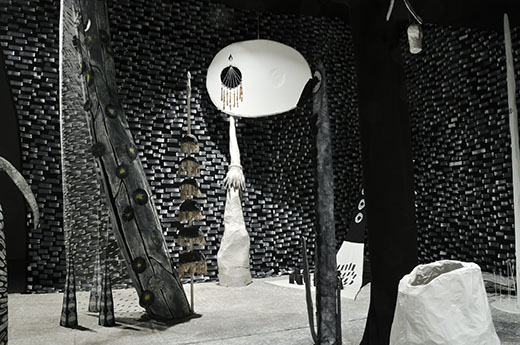
Most of the collage above is taken up by images of Matthew Ronay’s installation Between the Worlds (2010). I added images of mushrooms from an old biology poster and some scrap bits of painted paper. The dark, burned wood reminds me of these recurring nightmares I had when I was young. Wild wolves hunting me through a pine forest with nowhere to hide, no low branches to climb up on, no escape. I never saw or heard the wolves, I just knew they were behind me and getting closer, like an evil presence. As a child I had visited this pine forest many times on family vacation, it was never daunting or scary on those sunny days. In my dreams the pine forest looked exactly the same, I felt I could even distinguish individual trees, except now it was dark and only a pale light lit the scenery.

When I created this collage, I didn’t actually research or even look up the installation, I just intuitively used the images in my collage. Reviewing the collages now, I’m curious about this artist, his work and his intention. I think this might be a new favourite!
Reading about this installation, looking at photographs and considering the title, it is clear that Ronay created a liminal space, an in-between space. A space that’s neither everyday nor dreamscape. A journey into a forest symbolises a journey into the unknown and Roney’s woods are definitely unknown. It is filled strange handmade sculptures which look like altars for pagan deities or spirits. He sees the making of the pieces not just as making objects, but as a transference of energy.
Ronay is inspired by Carl Jung and Joseph Campbell (The Power of Myth, 1988) and “works with his intuition in order to reach an expression that reach us at a fundamental and collective unconscious level [to create] strange remembrance of something primal and instinctively original that lies deeply buried in the consciousness of modern man.”
Between the Worlds is very different from his other work in that it is dark and rough where his other work is much brighter, smooth, almost cartoony.

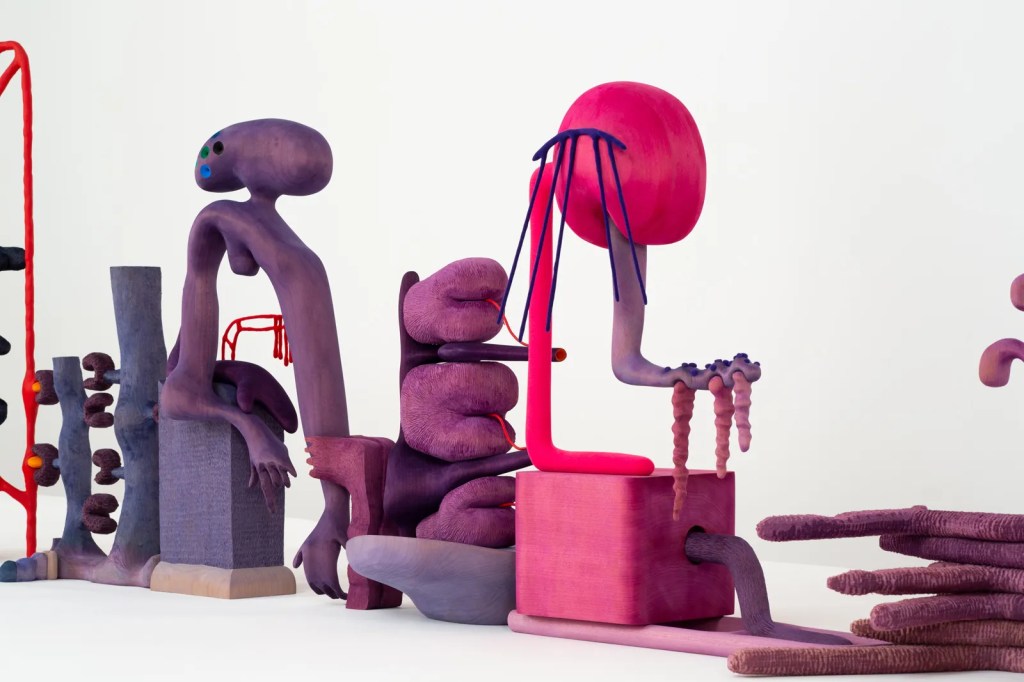
https://www.artforum.com/events/matthew-ronay-7-250586/
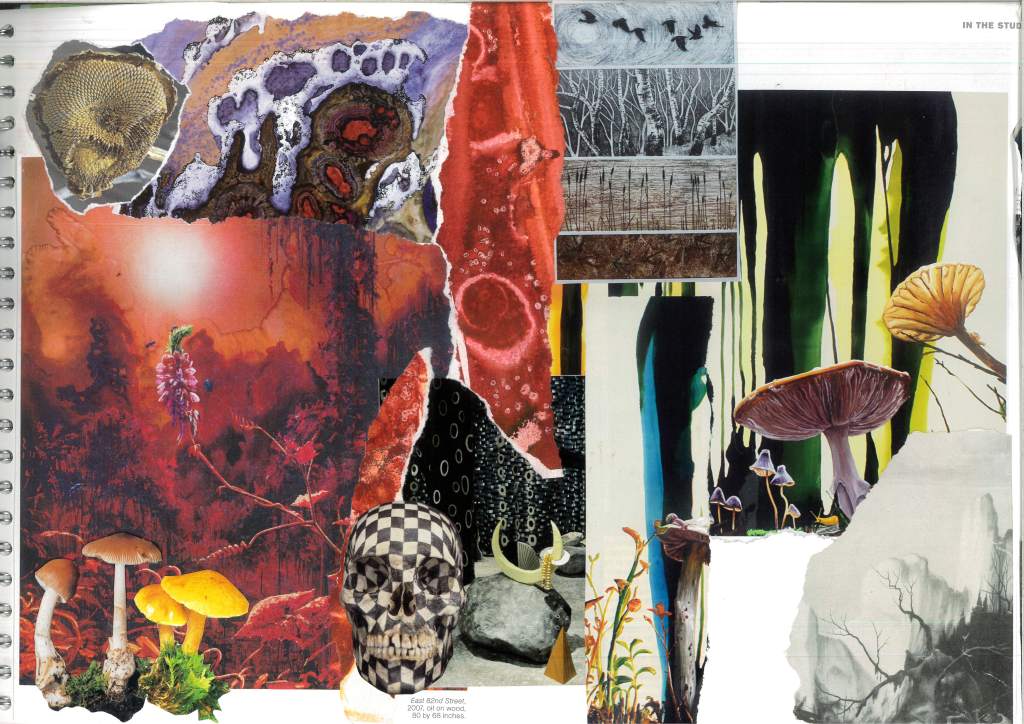
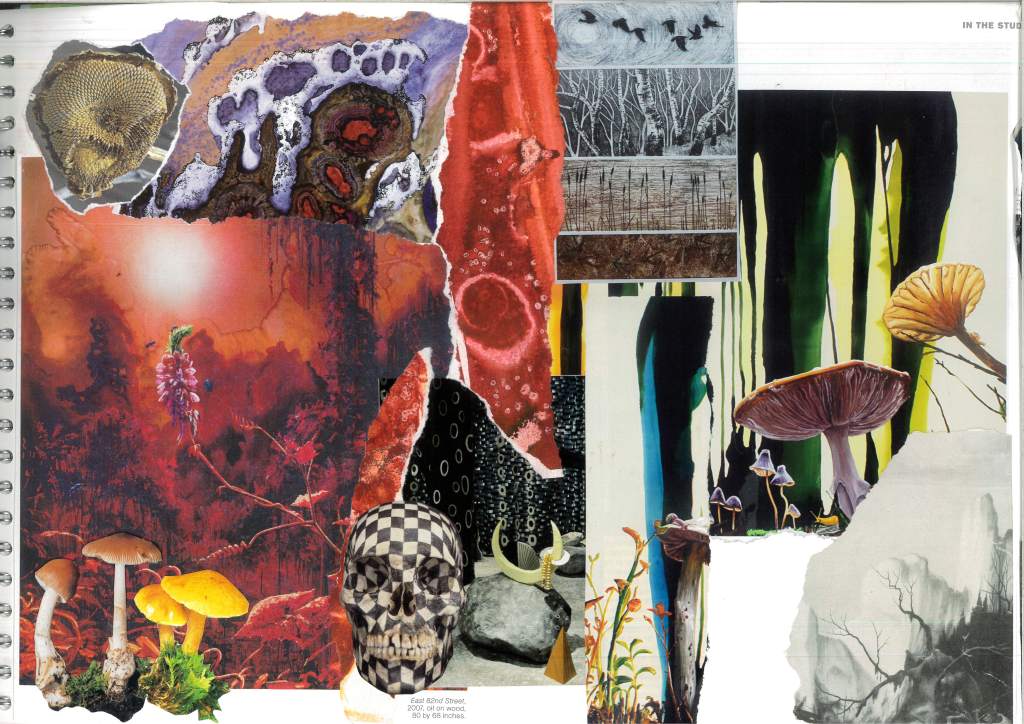
The second collage consists of more mushrooms, bits of painted paper and several found images from art magazines. I’ve added the works and citations below.

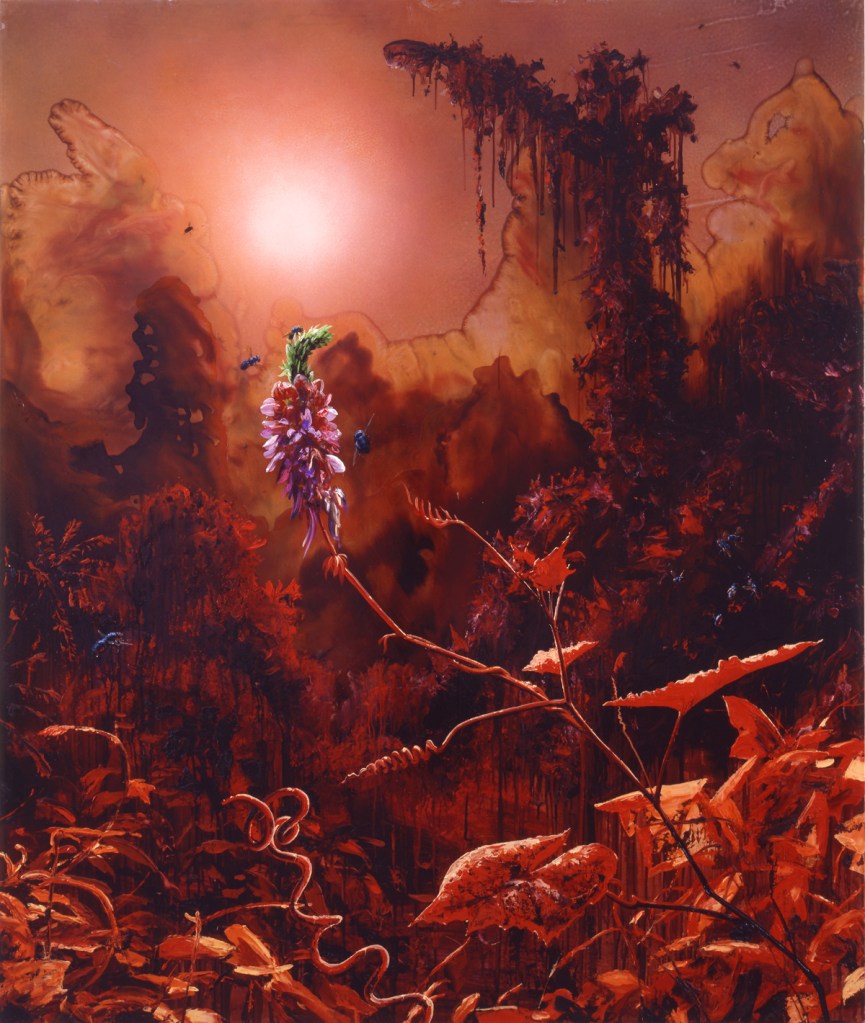
Alexis Rockman, East 82nd Street, 2007.
https://web.colby.edu/thelantern/2019/11/12/murder-chaos-and-fornication-dystopian-environmental-futures-in-alexis-rockmans-paintings/
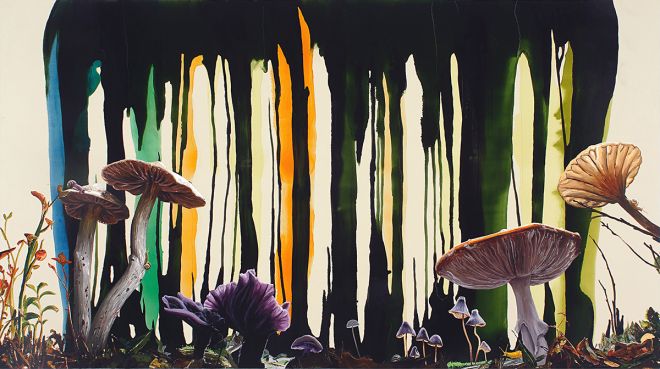
https://www.pismowidok.org/en/archive/2018/22-how-to-see-the-antropocene/self-capture-in-the-anthropocene
I’m especially drawn to Alexis Rockman’s East 82nd Street (2007). This oil painting on wood shows a saturated, hot, damp and almost fleshy forest. Very different from Matthew Ronay’s forest where the light is stark and the forms hard and dry. From looking at this image, I can almost hear the buzzing of flying insects and the squelching of mud under my feet. I think the mushrooms feel more at home here than in Between the Worlds (2010).
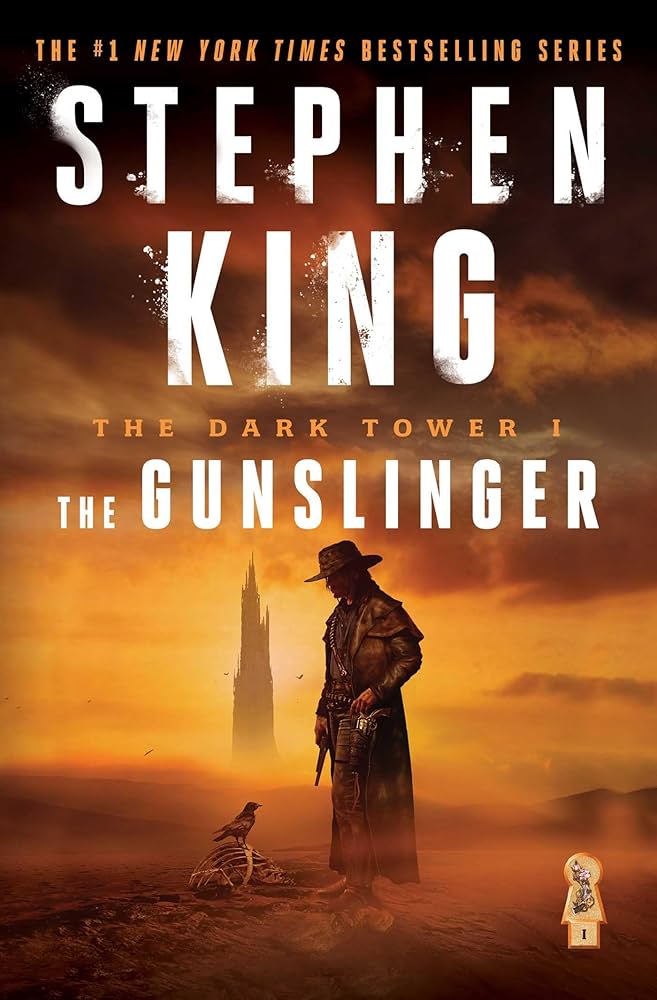
It also reminds me of some of the scenery Stephen King describes in The Dark Tower series. In book 1, The Gunslinger, chapter “The Slow Mutants”, where Roland and Jake encounter mutated creatures with green glowing skin in a cave.

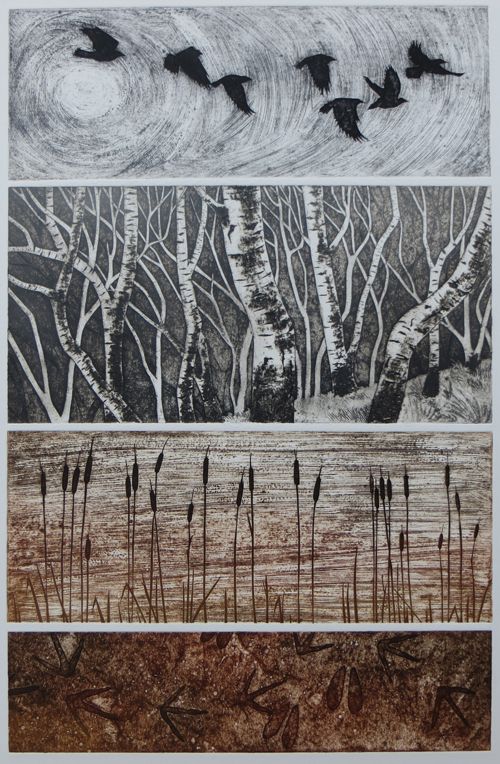
After being haunted by dark spirits in the dry and black woods, it’s not much of a relief ending up in the mud and heat. Perhaps Hester Cox’ birch trees, reeds and sky filled with birds is our final destination, but it seems still a long way to go. Or perhaps it’s a dream of nature past, in a world polluted and inhabited by mutant creatures as depicted by Alexis Rockman in which he warns us about our destructive relationship with the environment.
Citations
“Between the Worlds.” Artpace, artpace.org/exhibitions/between-the-worlds/. Accessed 11 Sept. 2025.
“Joseph Campbell and the Power of Myth.” Wikipedia: The Free Encyclopedia, last edited 28 July 2025, en.wikipedia.org/wiki/Joseph_Campbell_and_the_Power_of_Myth. Accessed 11 Sept. 2025.
King, Stephen. The Dark Tower I: The Gunslinger. Revised and expanded ed., Scribner, 2003.
Magdeburg, Rachel. “Self-Capture in the Anthropocene: The Expedition Paintings of Alexis Rockman.” View. Theories and Practices of Visual Culture, no. 22, 2018, http://www.pismowidok.org/en/archive/2018/22-how-to-see-the-antropocene/self-capture-in-the-anthropocene. Accessed 11 Sept. 2025.
“Matthew Ronay.” Artforum, “Events,” artforum.com/events/matthew-ronay-195928/. Accessed 11 Sept. 2025.
“Matthew Ronay.” Wikipedia: The Free Encyclopedia, last edited 6 May 2024, en.wikipedia.org/wiki/Matthew_Ronay. Accessed 11 Sept. 2025.
Sant, Ingrid. “Murder, Chaos, and Fornication: Dystopian Environmental Futures in Alexis Rockman’s Paintings.” The Lantern, 12 Nov. 2019, web.colby.edu/thelantern/2019/11/12/murder-chaos-and-fornication-dystopian-environmental-futures-in-alexis-rockmans-paintings/. Accessed 11 Sept. 2025.
“Q&A: Matthew Ronay.” Frieze, frieze.com/article/qa-matthew-ronay. Accessed 11 Sept. 2025.

 Where the Art is
Leave a comment